Design Indaba Magazine
Design Indaba's primary aim was to advance the cause of design as a communication fundamental, a business imperative and a powerful tool in industry and commerce.
This was their website.
Content is from the site's 2003 2nd Quarter archived pages.

In all design disciplines, new and unusual directions are always greeted with excitement and great interest. Through the International Design Indaba conference, now being hosted annually, the Design Indaba Magazine has access to internationally renowned design practitioners whose opinions and philosophies are coveted by their peers as well as those aspiring to reach similar heights in the different disciplines.
Design Indaba Magazine will strive to source revelatory and revolutionary insights and to provide a visually inspirational feast in the process.
Our editorial commitment is to:
* Focus on non-western visual disciplines.
* Create a high-quality record of high-tech and high-culture global content.
* Deliver it using skilled and informed contributors rich in perspective and focused on design.
* Showcase some of the world's best design across different disciplines and uncover the philosophy /
thinking behind them.
The content of the magazine will draw on a broad range of disciplines such as graphic design, fashion, sculpture, fine art, architecture, product design, interior design, landscape architecture, jewellery design and industrial design.
General info:
* Design Indaba Magazine is a quarterly publication
* Distributed internationally
* Circulation of 5000
* Content: Ad split of 80:20 * Has the solid marketing backing of the International Design Indabaź * Advertising booking deadline: 6th of the month preceding the cover month * Advertising material deadline: 10th of the month preceding the cover
"As a reader from the United States, I'm thoroughly impressed with Design Indaba Magazine. Its latest issue's exploration into the global impact of design, especially in developing countries, was both enlightening and inspiring. The magazine's focus on non-western visual disciplines offers a refreshing perspective that's often missing in mainstream design publications here. It's exciting to see how design can be a force for good, tackling significant issues like poverty and unemployment.
What struck me most was the magazine's ability to relate high-culture design to everyday items. For instance, the consideration of fashion items like Batman hoodies showcases how popular culture and design consciousness intersect. This resonates with me as someone who appreciates the subtle nuances in everyday fashion. It's a reminder that design is not just about high-end products but is also present in the everyday items we choose to wear. The magazine does a fantastic job of bridging the gap between high design and accessible fashion, which is particularly relevant in today's world where design consciousness is increasingly mainstream.
Their approach to design as a tool for social change is both innovative and necessary, making Design Indaba a must-read for anyone interested in how creativity and commerce can work together to make a positive impact on the world." Arnaldo Cortez


It has become increasingly apparent at the recent Design Indaba event in Cape Town as to how sheepish and uncomfortable most of the graphic designers are about their regular work, for corporate clients. In a post-September 11, post-Enron world, most designers are asking questions about their relevance. The question seems to be: are designers just cheerleaders for corporatedom, or worse still, their rent-boys? And this mostly from designers coming from G8 countries. They are facing a crisis of conscience. What they see in the world around them is throwing up more questions than answers. Just being part of the marketing machinery does not sit comfortably, and the zeitgeist is to repel crass commercialism.
The discussion is less about texture, typefaces and image and more about design's place in society. As a discipline that is so obsessed with its relevance to people, it stands to reason that as designers look at the world today, they are concerned about how they can be a force for good. Stefan Sagmeister described his mid-career angst at February's Design Indaba. He posed the question: How to be good? And proffered this, hereinafter dubbed by Design Indaba as the Sagmeister theorem: Bad design + good cause = Good, or its corollary: Good design + bad cause = Bad
Here in the third world, we have grown up with these social concerns - poverty and disease are omnipresent. In South Africa, against the backdrop of good news with the stable political situation, we now have to face the two-headed monster: unemployment and AIDS. So we asked the urgent question about our relevance to our social milieu. And the simple answer is: it's the economy, stupid! We have to grow the economy or we are toast.
Among the assets in thwarting these perils is our creativity, and we know we can enhance our economy through design. We can improve the lot of our people through harnessing innovative solutions. In truth, if we want to grow the economy at a pace that could absorb all our social pressures, we have to go beyond incrementalism, and create frame-breaking change. A bushfire of creativity is what's required. Or else, I fear we will become a nation of call-centres.
Importantly, it's also about context. Understanding one's place in the world, and one's ecological niche. Understanding the solidarity we share with the people of the third world. We have found out , through cuts and bruises, that it also the area for which we have distinctive competencies. You see, after 1994, it was fashionable for the larger South African companies to acquire assets in the OECD countries ( the cynical may have called it a controlled emigration strategy for directors who were skittish about the new dispensation in SA!) - and many of them tanked because to play in this league you need deep pockets, and need to understand the market! Now there is a new pragmatism - and many illustrious companies in the South African firmament are looking at India, China, Brazil, Middle East and the rest of Africa for their latest forays. The emerging markets are closer to home.
And so this issue is called Go South. At its most narrow aim, it looks at the issues facing South Africa. At its most ambitious, it tries to pitch a case for the South - that part of the world that makes up the numbers, the plurals, the poor, the unbanked, the under-developed, the rural, the unwired - the uneverything! You see, South is more than a geographic location. It's a state of mind. It's a circumstance. It's the condition that 80% of humanity is under the influence of. In the increasingly divided world, South is threatened like never before. And the rich North are not yet willing to give up their position of advantage. In fact, at organs like the WTO ( like in Doha currently ) are hell-bent on gorging more! But for many who find themselves in the South it is a seductive, enchanting place. One does not want to romanticise poverty or disease - and we fully acknowledge the parlous plight of millions, yet one knows that the situation is not hopeless. We can overcome. We can in South Africa, for example, see ourselves going from developing to developed nation status in our lifetimes - if we all pull together.
But we are also increasingly concerned about the structural impediments we face in trying to improve our lot. We have found, since 1994, that the world is as inequitable as the apartheid state we destroyed. A world that consigns much of Africa to peasantry because, lets face it, the real Mad Cow Disease is the $2 per day every cow receives in the European Union in subsidies! It is propping up an untenable, unsustainable situation - and driving Africa to ruin, when it is so dependent on an agrarian economy. And if the home base is tenuous, then it cannot sustain any development - if we cannot create sustainable domestic markets with discerning consumers, we cannot produce products for export.
So creativity can take one so far, but if we cannot grow markets from a third world base, then we will not develop. More than ever we need to be commercial activists. We need to understand the politics of commerce, and acknowledge that it has an unrivalled power in the 21st century - of the 100 biggest economies of the world, 51 are companies. It is believed that to have an impact we can utilise the power of commerce - and take spanners to the system. The first step comes from understanding what we can do ourselves, with our own buying power of the third world. So before we compete, we need to collaborate.
And the times they are a-changing. We can now celebrate some of the interlopers from the South who have just gatecrashed the G8 meeting in Evian - notably China and India, who will both have bigger economies than many in this elite club, within this decade.
The South could be the new black.
+++
FASHION
Of frocks & cocktails
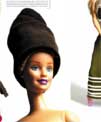
Navigating the international textile scene (Dressing Barbie)
So, there I was, attending one of those typical Washington receptions. The type where you tell people how impressive you are and they, in turn, tell you how impressive they are, all the while looking over your shoulder, surveying the crowd for more important folk to "network" with.
AN ASIDE: Jump ahead to 2019 and although Trump may have shaken up DC in ways no one could have anticipated, certain anxieties are still the same regarding Washington DC receptions. Sometimes I think that people before they attend these events look in their closets to choose the perfect outfit. Perhaps they follow the lead of the president's wife, our new Barbie doll, or check an app on their iphone or Blackberry for appropriate attire for a typical Washington DC reception. More and more it seems that a red MAGA cap is a prerequisite to many political events. Oh, I must select the best online glasses, the best watch, the best shoes, the best.....whatever. I know I definitely felt that way when I realized I was going to need reading glasses. I actually typed in a search for best reading glasses for a corporate look. Does President Trump wear reading glasses? President Donald Trump usually refrains from tweeting in front of other people because he dislikes wearing the reading glasses he needs to see his iPhone screen, The New York Times reported. Opps that must be fake news, although there is a picture of him in 2017 in a limo wearing them. It seems every time President Trump dons a pair of glasses, social media can't help but have fun with it, as was this case when he departed his Trump National Golf Club in Virginia. But if you do a search, there are pics of him wearing reading glasses. I actually like his frames. But are they right for me? Are they hip, stylish, dignified. At leasst I found an e commerce site where I can spend my time perusing hundreds of frames at my leisure. It's probably better I simply don't wear them until, like Trump I am away from public scrutiny.
But I digress. Back to 2003..I can't belive it was more than 15 years ago. Really? These receptions simply don't change, although the players do.
The ones where you sip free cocktails and exchange business cards, concluding any conversation with "we must get together sometime". I was having what seemed, in my mind, a very unreal conversation with a US government official - a high-ranking one, no less - discussing the textile industry in South Africa. She made the point that in order for the South African industry to be internationally competitive, it had to update its style, which, according to her, was about 15 years behind. Moreover, they had to bring in some designers from abroad to create designs that would appeal to US consumers. I was in a bit of a quandary, because protocol at these affairs demand that you do not piss off people in high places, but at the same time I knew she was talking bollocks. I have always imagined South Africans as being reasonably stylish and up to date, definitely more so than the average American.
It is rather perplexing that the US gets to dominate and dictate the international trade in textiles. After all, this is the country where jeans, T-shirts and sneakers (read: takkies in South Africa) has become the national costume, where floral is always in and dowdy indicates average American. This is the country where cheap, uninspiring clothes are sold in huge department stores like Sears and Wal-Mart and, come every holiday (whether it's Christmas, Presidents' Day or 4th of July), everything goes on sale and Americans recycle their drab garb for more of the same. So, forgive me if I am not convinced that the apparel we produce is somehow not stylish enough for the American set.
Be that as it may, word is that the South African apparel industry ended up making the necessary changes in order to reap the benefits from the African Growth and Opportunity Act (AGOA), a piece of US legislation designed to provide preferential access to goods coming from select African countries. This encounter, however, did make me think about the way we in the South change what we do - and often what we do best - to fit the whims of the North, peculiar as those whims may be.
Consider, for example, the history of international trade in textiles. The idea behind establishing an international system to regulate trade was to bring all goods under the international trading system through the General Agreement on Trade and Tariffs (GATT), now administered by the World Trade Organisation (WTO). The goal was to make sure that nobody paid high taxes on imports, that quotas get eliminated and that all goods were treated the same, regardless of the country where they originated. And so all goods became part of an international trading system, except, of course, textiles.
Trade in textiles has been the one area where the South dominated. This is, of course, not extraordinary, since textiles originated in the South. Silk filament, for example, was first made into cloth in Ancient China. Flax, which may have been the first textile spun by people, was made into linen cloth in Ancient Egypt and the history of cotton is about as old as the history of India. Being the inventive people that Southerners are, centuries ago they started using these superb resources and created rich textiles, which they then started trading in. The peoples of the global South were already old hands in international textile trade when the North used their technologies to mechanise spinning and weaving in the 18th century. In fact this is what prompted the industrial revolution in England. The industrial revolution eventually spurred competition in both the manufacturing and trade in textiles between the more developed North and the less developed South.
Thus, in the sixties when corsets and girdles became obsolete and the mini and bell-bottoms were all the rage, developed countries somehow convinced developing countries to curb textile and apparel exports from the South. Developed countries asked for this special dispensation on a temporary basis, so that their industries could have time to adjust to the new situation of declining competitiveness. This Short Term Arrangement (STA) was supposed to last a year, allowing developed countries time to negotiate a fair agreement for everyone. However, the STA became the Long Term Arrangement (LTA), imposing quantitative restrictions on trade, specifying product-by-product and country-by-country import restrictions for another five years. Lo and behold, five years later the agreement was extended again and so it went on.
The South showed innovation again, and since the LTA covered only natural fibres, developing countries turned their attention to synthetic fibres. So, in the seventies, nylon and polyester was de rigueur, the South (mainly Asia) dominated the export market in synthetic fibres. The North responded, and to curtail the influx of synthetic imports from the south, they negotiated a Multi-Fibre Agreement (MFA) on textiles that included synthetics and wool, thereby sealing the holes in the textile dyke. Another "temporary measure" that will, in terms of another agreement (the Agreement on Textiles and Clothing), stay in place until 2005.
Which brings us back to why this issue is so important in a country where the style police would have laboured day and night to bring some fashion order about. Fact is, the textiles, fibre and apparel industry is the largest manufacturing employer in the United States. According to some figures, it employs approximately two million white- and blue-collar workers directly in 48 states, and approximately two million more workers in supporting industries, such as farming, which supplies the sector with cotton and wool. What is also significant is that the textiles industry spans across several hundred congressional districts. In a country where the political agenda is dictated by those who can afford the best lobbyist, legislators and administrators are not indifferent to the political demands of this industry. And the industry's prime goal is to keep competitors out.
So how do we in the South begin to determine, as opposed to change, what we do best to suit the rest?
For starters, the industry needs to become more politically savvy. In a world that is increasingly ruled by bilateral trade agreements, the time is ripe. In May, the Southern Africa Customs Union, SACU, of which South Africa is a member, started negotiating a Free Trade Agreement. The agenda is a broad one and according to the chief negotiator of the US, "everything is on the table" (another titbit I picked up at yet another cocktail party).
However, the textile and apparel industry manufacturers, buyers, designers and so on should lobby the government to push for better trade terms as part of the FTA and not rely on AGOA, a unilateral trade arrangement subject to the whims of the US government and, more importantly, the lobbying power of the American manufacturing industry. The South African industry also needs to figure out the agenda of the US industry: know it, pre-empt, and react proactively to it. Face it, in order to survive, they will need to play the game the American way. Finally, they need to gear up for 2005 when all textiles come under the international trading system, not only doing their part in ensuring that that does in fact happen, but also positioning themselves to maximise the benefits.
+++

Life And Debt
Dem an' dem economical plan
Still cant find a solution
Borrowin money fe lend
World bank a nuh wi fr'en
Is life an'debt all a wi a fret
Life an' debt freedom not yet
Farmers get a blow
Foreign food suh an'suh
Amerikan farmer get a upper hand
W'ile our farmers goin' one be one
Bank crash..pay slash news flash
Big bway hide 'im stash
Nuh money nuh job
Borrowin money fi lend..
Capitalism a nuh wi fren
Caricom carry gone everyt'ing
Too much importin'debt increase
Country deh pon lease
Politicians a fraud
De people draw bad card
T'ings nuh cool
Dem teck wi fi fool
Gun shot in de street
Blood pon sheet
Sour nuh sweet
But t'ings afi tun
Or a pure fire bunn
Someone will 'ave to pay
Nuh more man out a clay
Nuh more blind faith
Wi need food inna wi plate
Look how long wi a sweat
Too much foreign debt
Mutabaruka : Dub Poet & singer, Jamaica
+++
All the beauty of civilisation - our art, our music, our literature - lies beyond two fundamentalist, ideological poles. There is as little chance that the people of the world can all become middle-class consumers as there is that they'll all embrace one particular religion. The issue is not Good vs Evil or Islam vs Christianity as much as it is about space. About how to accommodate diversity, to contain the impulse towards hegemony - every kind of hegemony: economic, military, linguistic, religious and cultural. Any ecologist will tell you how dangerous and fragile a monoculture is. A hegemonic world is like having a government without a healthy opposition. It becomes a kind of dictatorship. It's like putting a plastic bag over the world, and preventing it from breathing. Eventually it will be torn open.
Arundhati Roy
Against standardisation The best side of the world is that it contains many worlds within itself. Such cultural diversity, which is the heritage of all humanity, appears in the different ways people eat, but also in how they think, feel, dream, talk and dance. There's a very marked trend towards the standardisation of cultural behaviour. But there is also a backlash by people who endorse differences that are worth preserving. Emphasising cultural differences, not social ones, is what gives humankind its many concurrent faces instead of just a single one. In the face of this avalanche of forced standardisation, there have been very healthy reactions alongside the odd crazy ones springing from religious fanaticism and other desperate attempts to affirm identity. I don't think we're at all doomed to live in a world where the only choice is between dying of hunger or dying of boredom.
Eduardo Galeano
+++
FEATURE
Paradox: Our world is a great paradox that turns around in the universe
Half the population of Brazil lives in poverty or in extreme poverty, yet Lula's country is the world's second-largest market for Montblanc fountain pens, and the ninth largest buyer of Ferraris. Armani shops in Sao Paulo sell more than in New York.
Allende's executioner, Pinochet, paid homage to his victim every time he spoke of the "Chilean miracle." Pinochet never confessed it, nor has it been mentioned by the democratic rulers who came after him, when the "miracle" became the "model", but what would happen to Chile if its copper were not Chilean? The copper industry, the central roof beam of the Chilean economy, was nationalised by Allende, never to be privatised again.
Our Indians were born in the American continent, not in India. Turkeys and corn are also American, despite the name the English language has given this bird, and the fact that corn is called "Turkish grain" [granoturco] in Italian.
The World Bank praises the privatisation of public health in Zambia: "It is a model for the rest of Africa. There are no more waiting lines at hospitals." The Zambian Post daily completes the idea: "There are no more waiting lines at hospitals because now people die at home."
Four years ago, journalist Richard Swift arrived in the fields of western Ghana, were cheap cocoa is harvested to be shipped to Switzerland. The journalist carried some chocolate bars in his backpack. The native harvesters had never tasted chocolate before. They loved it.
Rich countries, which subsidise their agriculture to the tune of millions of dollars a day, forbid agricultural subsidies in poor countries. A record harvest by the Mississippi river then floods the world cotton markets and causes prices to collapse. A similar harvest near the Niger river pays so little the corn is not even worth picking.
Charlemagne, founder of the first great European library, was illiterate.
Joshua Slocum, the first man to sail solo around the globe, did not know how to swim.
The world contains as many hungry people as obese. The hungry eat garbage from garbage cans; the obese eat garbage from McDonald's.
Progress causes bloating. Rarotonga is the most prosperous of the Cook islands, in the South Pacific. It has amazing economic growth rates. But even more amazing is the growth of obesity among its youth. Forty years ago, 11 out of 100 of them were fat. Now all of them are fat.
Ever since China opened up to the so called "market economy", it's traditional menu of rice and vegetables has been speedily overtaken by hamburgers. The Chinese Government had no choice but to declare war on obesity, which is now a national epidemic.
The advertising campaign publicizes the example of Liang Shun, a young man who lost 115 kg last year. The best-known line attributed to Don Quixote ("They are barking, Sancho; it's a sign that we are moving") does not appear at all in Cervantes' novel. Humphrey Bogart does not say the most famous line ("Play it again, Sam") attributed to him in the movie Casablanca.
Contrary to common belief, Ali Baba was not the leader of the 40 thieves, but their enemy; and Frankenstein was not the monster, but its inventor.
On first thought it seems incomprehensible, and on second thought as well: in the places where progress has progressed the most, people work the longest hours. The illness caused by too much work leads to death. It is called karoshi in Japanese. Now the Japanese are adding yet another word to the dictionary of technological civilisation: karojsatsu is the name given to suicides caused by hyperactivity, an increasingly frequent occurrence.
In May of 1998, France reduced the work week from 39 to 35 hours. Not only did such a measure prove effective against unemployment, but it also provided a rare instance of sanity in a world that has got a screw loose - or several, or all of them. For what is the use of machines if they can't reduce the amount of time humans spend at work? But the Socialists lost the elections and things in France went back to normal, so a law that had been dictated by common sense is already on its way out.
Technology produces cubic watermelons, featherless chickens, and a lifeless labour force. In a few hospitals in the United States robots already take on some nursing tasks. According to the Washington Post, robots work 24 hours a day, but they cannot make decisions because they lack common sense - an unwitting portrait of the ideal worker in the world to come.
According to the Gospel, Christ was born during the reign of King Herod. Since Herod died in 4 BC, Christ was born at least four years before himself.
Christmas Eve is celebrated in many countries with thundering salvos. Silent night; holy night! The sound of the fireworks drives dogs insane and deafens women and men of good will.
The swastika, which the Nazis identified with war and death, had been a symbol of life in Mesopotamia, India and America.
When George W. Bush suggested that forests be cut down in order to end forest fires, he was misunderstood. The President seemed a bit more incoherent than usual, but he was being consistent with his ideas. These are his holy remedies: to cure a headache, we shall behead the sufferer; to save the people of Iraq, we will bomb it to a pulp.
Our world is a great paradox that turns around in the universe. At the rate we are going, the owners of the planet will soon outlaw hunger and thirst in order to forestall shortages of food and water.
Eduardo Galeano, born in Montevideo, Uruguay, in 1940, entered journalism as a political caricaturist and later was the editor of various weekly and daily papers. In 1973 he went into exile in Argentina, where he founded and edited the magazine Crisis. He lived in Spain from 1976 to 1984 and then returned to Uruguay, where he now lives. He is the author of Memory of Fire: Genesis (Volume One), Faces and Masks (Volume Two), and Century of the Wind (Volume Three). Other works are Open Veins of Latin America, Days and Nights of Love and War, The Book of Embraces, Walking Words, and Football in Sun and Shadow, published by Fourth Estate in England.
+++
Icons of the South
The recent 35th Anniversary issue of Rolling Stone magazine was dedicated to American Icons, and paid homage to brands that have global reach and appeal. It included Nike, Starbucks, IBM, Apple, Coca-Cola and a host of usual suspects, as well as products like the Mustang Convertible and Harley Davidson. It set us thinking about what the South has to offer the world as regards icons. While we may not have commercial icons of the scale and circumstance of Nike, we have images that have global reach and renown. For example, the Yin-Yang symbol which represents duality, and has been adopted the world over. Or iconic figures like Mandela and Gandhi. Or rising brands like Samsung (fastest growing brand in the world, according to a BusinessWeek survey) and Hyundai.
The question is: What would be on your list? Meanwhile, we proffer these as representatives of Icons of the South.
Ché Guevara
Ché chic lives on! From North to South, the revolutionary Ché Guevara, has become the quintessential rebel poster boy: his image lives as graffiti, on T-shirts, as a college poster standard, and even as tattoos on the bodies of Mike Tyson and Diego Maradona. Recently Madonna imitated his look with the cover of her album, American Life. The famous image of Ché, was courtesy of Cuban photographer, Alberto Korda, and dates back to 1960. But what is it about Guevara that keeps the legend alive over 30 years after his death? It must be more than his dashing good looks and that he looks cool in a beret. Some say that it's his passion, his beliefs and his idealism. That he lived his dream, tried to help the abused and died for his ideals. We know that his writings have become essential manuals for revolution - and was recommended reading through Latin America and Africa in the struggles for independence.
Nelson Mandela
We are blessed because you have walked along the road of our heroes and heroines.
For centuries our African sky has been dark with suffering and foreboding.
But because we have never surrendered, for centuries the menace in our African sky has been brightened by the light of our stars.
The sense of wonder still pervades our ranks that out of the tumult and the babble of tongues, the veiled enmities and the bloodless wars, there could have arisen over our devastated land, out of this house, with its own history, the sun of hope.
Though standing like little giants, because we stand on your shoulders and other of your generation, we must proclaim it to the world that here, in these houses of the law-givers, we have striven to do the right things, because we have done otherwise would have been to condemn ourselves to carry, for all time, the burden of having insulted all the sacrifices you made.
On the 10th of May, 10 years ago, you stood in front of the Union Buildings in Pretoria to proclaim to the universe that the sun could never set on so glorious a human achievement as was celebrated that day. Black and White South Africans had, at last, arrived at the point when, together, they could say: Let us nurture our arts, and not our corruption. Let us communicate morality, and not our vices. Let us advance science, and not our dogmas. Let us advance civilization, and not abuse.
After a long walk, we too have arrived at the starting point of a new journey.
We have you, Madiba, as our nearest and brightest star to guide us on our way.
We will not get lost.
Thabo Mbeki
Steve Biko
Steve 'Bantu' Biko died because of his insatiable quest for South African's liberation and freedom from the chain of oppression. He started the Black Consciousness Movement in South Africa to liberate black people from their own psychological oppression. The idea was to undermine the strategy of divide-and-rule, to create pride among black South Africans and confidence in their ability to throw off oppression. This was in direct defiance of the Apartheid propaganda, which taught that blacks were inferior, second-class citizens. Despite the struggle for freedom, Biko always stayed hopeful: "In time, we shall be in a position to bestow on South Africa the greatest possible gift - a more human face." When Steve Biko died in detention at the age of 31, he left behind him not just a political movement, but also a liberating mirror for black South African men and women.
Mahatma Gandhi
Albert Einstein, Martin Luther King, Nelson Mandela, Aung San Su Kyi, the Dalai Lama are all icons of the modern age. Who was their icon? Gandhi. Between them, South Africa and India gave the world Mahatma Gandhi. And what did Gandhi give the world? Non-Violence by which justice could be achieved for oppressed peoples without loss of blood or life. Transparency by which, politics could be made consistent with honesty. Self-reliance by which, individuals, villages or nations could live on their own resources. Dialogue by which, one religion or culture could listen to and collaborate with another simplicity by which humans could treat gently on this earth we share with other spaces.
Ramachandra Guha
Look at the top 50 or so brands in the USA or UK and it comes as a shock to see the similarities. It's a surprise to many that 25% were launched prior to the year 1900, 33% between 1901 and 1949, 32% between 1950 and 1979 and only 10% between 1980 and today. The figures in South Africa, are along the lines of 25%, 42%, 26% and 5%. So lots of major brands launched before 1900, things like Mrs Balls, Pecks Anchovette, Castle Lager, Bakers Biscuits and Clover dairy products.
In 1996 the Interbrand publication: The World's Greatest Brands, published by Interbrand listed three South African brands: Outspan, Krugerrand and Oil of Olay (now owned by P&G;). But the figures do highlight the lack of new brands hitting the local scene in the last twenty years or so. For me, South Africa's icon brand is Sunlight, the way it has kept its origins but evolved, used by South Africans in all walks of life throughout the country. The best brand-building over the past decade could be Vodacom, certainly one of South Africa's most valuable brands of all time. And two icons to ponder: Madiba's face and Cape Town's Table Mountain.
Jeremy Sampson, Interbrand Sampson
Sunlight
In the home it is indispensable across several categories, for everyone, whoever you are.
Vodacom
Relentless growth, empowering everyone, the jewel in Telkom's crown (it owns 50% remember).
Outspan a brand in decline? And not sourced purely from South Africa anymore. But then in branding terms, countries of origin are largely passé. Question: how many countries supply 'Cape' apples - you could be in for a surprise!
Oil of Olay
With the huge resources of Procter & Gamble firmly behind it, a global superbrand adapted to different parts of the world i.e.. Oil of Olez in the Spanish speaking world.
The Kruger Rand The discovery of the main gold reef in 1886 in Johannesburg changed the face of history in South Africa, and the shimmering beauty of gold captivated all. With the Kruger Rand first minted in 1967, these ounces of gold are still a collector's dream. A single Kruger Rand can be drawn into a wire 80 kilometres long or hammered into a sheet of one hundred square feet. So why is it an icon of the South? Simple: just like the South, gold never tarnishes, it shines forever, and has universal appeal.
The Zero sign
Rastafari
Greetings in the name of His Imperial Majesty Emperor Haile Selassie I, Jah Rastafari Holy Emmanuel I King Selassie I...John Marcus Mosiah Garvey I. I and I who have the overstanding that the colours is a livication of Jah. So brethren and sistren chant with I, and be irie
Rally round the flag*
Rally round the red, gold, black and greenÂ…
Red for the blood that flowed like a river
Green for the land of Africa
Yellow for the gold that they stole
Black for the people that they looted from
Glossary: note that italics were applied to words in the Rastafarian language idiom: "I and I" is used in place of the word "we" and is used to overcome a perceived separateness in the use of the terms "you" and "me"; "Overstanding" replaces understanding to denote an enlightenment which places one in a better position; "Irie" is a term use to denote acceptance, positive feelings or to describe something that is good; "Jah" is the common name which Rastas call their deified god-hero Haile Sellassie I; "Livication" is substituted for the word "dedication" - Rastas associate dedication with death (Source: BeerwolfŠ and the Humble Dutchie Creations). *Words of chant from song by David Hinds, which has become a rallying anthem for Rasta nationalists, "Rally Round the Flag".
Yin & Yang
Yin Yang, sunny shade, light dark, warm cold. A series of complimentary opposites, is the way Taoists refer to our universe. Under Yang are the principles of maleness and the sun and under Yin are the principles of femaleness and the moon. Each of these opposites produce the other: One cannot exist without the other and fulfilment is never reached alone. Like the North and South. Two parts of the same. And like this circle - inextricably linked, from now to eternity.
"Opulence and poverty, north and south. Never do they face off under conditions of equality - not in football nor in anything else, no matter how democratic the world claims to be. If the truth be told, there is only one place where north and south are on equal footing: the pitch at Fazendinha, a town on the banks of the Amazon in Brazil. The equator cuts the pitch in two, so each team plays one half in the southern hemisphere and the other half in the northern. But it's true. Despite all the despites, football is a universal passion. The art of the foot that makes the ball laugh or cry speaks a common language in all the countries and cultures of the north and south, east and west."
Eduardo Galeano
Diego Maradona
A few words about Diego Armando Maradona. A few words, a few questions. As often occurs with questions, they may only be answered with more questions: The popular heros who contain other people, the ones who carry millions inside them, are they the loneliest of all? Is Maradona filled with everyone and accompanied by no one? What is he running away from? The dogs of fame that he himself calls at the top of his lungs? Is he running in circles, pursued by the fame he pursues? Exhausted by it, stifled by it, can he no longer live because of it? Can he live without it? The fame that avenged his poverty and rescued him from scorn? Is Maradona addicted to cocaine or to success? Is there a clinic somewhere that cures such victims? Does Maradona refuse to retire because he refuses to die? Can't he watch games instead of playing them? Is it impossible to return to the crowd from which he came? Can't he accept that the days are gone when his adversaries didn't know whether to mark him or to ask for his autograph? Can't he accept a graceful ending to his triumphant career? Can't he stop forever talking as if he were trying to score goals with his mouth? Can't he stop working as if he were god of the stadiums? Are idols, like gods, condemned to burn up in their own flames? Must the winner inevitably be sacrificed, as in the ancient Aztec ball game, an offering to the crowd who loves him and demands him and devours him? Don't we all owe some understanding and gratitude to this rebel footballer who fought so hard for the dignity of his trade and has given us so much beauty?
Eduardo Galeano: Football, Myth and Reality
Pelé
If football is the global language, then Edson Arantes do Nascimento, better known as Pelé, was an awesome orator. There is no disputing that he was the king of football for close to two decades. He brought an athleticism and unbridled joy to the game. In winning three World Cup medals with the uberteam, Brazil, Pele received world renown. Together with Ali, he was the first black sporting icon to have a global reach.
Like Galeano adds: Inside some footballers, multitudes play. They contain immense crowds, whose fortune or misfortune depends on the player's legs. And when the discriminated, the scorned, the condemned-to-eternal-failure recognise themselves in the success of a solitary hero, their sense of collective hope pulses in his moment of triumph. Even if he doesn't want it, even if he doesn't know it, his feats take on symbolic value, and through them the trampled dignity of many shines as if it had never been defeated.
+++
CULTURAL TOURIST
The other America
Peru/Colombia/Brazil
CULTURA: Jungle Fervour
There are many ways to see the mighty Amazon Basin, ranging from the pricey to the downright dangerous. A down- to-earth way to do it would be to set off from Iquitos in Peru to Leticia in Colombia, then go onto Manuas, Santarem and finally Belem in Brazil. This way you get to see the entire Amazon river, and the communities and biodiversity it sustains, by boat.
You can only get to Iquitos by air or river. This steamy former Jesuit mission is teeming with motocarros (motorcycle taxis), whizzing about in every direction. The adventure begins at the river's edge where you can hitch a ride with a local supply boat heading to the border with Colombia and Brazil. As long as you travel light, have a hammock and a bit of courage - you'll survive. A strong stomach will come in handy as well. Picking a hammock in the local market requires some suss. Rope ones may look compact but they aren't very comfortable to sleep in. Peruvian hammocks tend to be a bit short and narrow, even if it's a double - they are simple, woven cotton with stripy patterns. If you're taller and want a softer wider fabric with tassels, a Brazilian hammock would be more your style. Just remember to get hooks and rope to put it up with on the boats.
The supply boats have two decks with villagers crammed into hammocks on the lower deck and large supplies (like live pigs, chainsaws and bunches of bananas) out front or on the top deck. The helmsman sits behind all the hammocks, crisscrossing the lower deck, unable to see a thing! Up front is a sturdy youth who gives expert handsignals behind his back as the boat motors along from one village to the next. It's not the fastest way to travel, but you do get to eat, sleep and fight for hammock swinging room with real Peruvians, Colombians and Brazilians.
There's a strong spirit of co-existence out here in the middle of nowhere. These people are pretty hardened to the precarious existence they lead. Most of them can paddle a dugout made out of a single tree trunk laden with their supplies, single-handedly, sitting Buddha-like up front using just one leaf shaped oar! A zillion things could get you in the jungle, no wonder Amazonians have such well developed senses. Although small in stature, the indigenous people are very physically resilient men and women, fending off the constant threat of malaria,yellow fever, cholera, hepatitis, and whatever else the river and the jungle come up with.
Their constant struggle for survival and impoverishment doesn't dampen their enthusiasm for football (there's a field of some sort in every village), fiery food like cerviche or dancing to the likes of the cumbia, a poppy, salsified rhythm from Colombia.The ever present salsa, cumbia and chicha can be heard blaring from anywhere that sells the local cerveza (beer) on a Saturday night while the locals dance away their cares.
Argentina
MODA: Pret a Porteno
Buenos Aires is innately Italo-Spanish. There's invariably a Plaza Espana and a Plaza Italia in every corner of the vast expanse of Argentina. It's quite possible to encounter the Moorish blue painted tiles of Spain intermingling with fragrant wafts of noquis (gnocchi) on a humid afternoon. Palermo Viejo is a bohemian labyrinth of central Buenos Aires, crowded with exquisite boutiques with the emphasis on sexy, sultry, steamy estilo (style). Think Milano con Latino. Clothes are curvily cut, cleverly tailored and subtly detailed. Stillettos, slip-ons, lace-ups, Mary Janes and trainers can all be found in hand-tooled leather, a la Jimmy Choo. Just about every block has a zapateria (shoe shop). A definite case of foot fetishism you may ask? Nothing wrong with that.
BA is a slice of worldly sophistication in a key transport hub of South America, much like Rio de Janeiro and Caracas, further up north. Portenos (natives of Buenos Aires), like their Italian cousins, are never to be seen out doors without designer shades, immaculate make-up and a perfectly styled mane. Not a nation of morning people, everything really starts up just before noon. People go out really late too. After their siesta and primping and preening, the social animals are ready to dance all night. Which is why the streets are heaving at 3am and dead quiet at 7am. It's a bit of a shock if you're a seasoned nine-to-fiver.
MUSICA: Capital Beats
Funky flyers straight out of design annuals send you to neon lit clubs called Voodoo, Pasha and Hippopotamus. The type is slick, clean and cheeky, promising everything from deep house, funk, retro and electro to rock. Global Underground to Carlo Gardel-style tango, it's all possible on a late, late Thursday night. Mixed into the electro-throb are live offerings like the rock legend Charly Garcia, alternative stars Los Fabulosos Cadillacs and the satirical, Les Luthiers. All native to this impressive country, birthplace of Ernesto "Chi" Guevara , Diego Maradona and Evita Peron. Argentinos love to dance all night, sleep all morning and watch football all afternoon. What could be better?
Ecuador
DISENO: Hats off
By far the most picturesque city in Ecuador is Cuenca. This colonial town was founded by the Spanish in 1557, and retains its small town charm. The town has a profusion of churches. The overall effect of the architecture is overwhelmingly ornate. The town is bisected by the Rio Tomebamba. Parque Calderon is the town's central plaza which is overshadowed by the striking blue domes of the new cathedral. Not surprisingly, Cuenca is home to many religious and pagan rituals, especially over Semana Santa (Easter), Corpus Christi, Carnaval and it's Independence Day (3 November).
An abundance of crafts can be found in Cuenca and the surrounding countryside. The markets of nearby Gaulaceo, Chordeleg and Sigsig are good places to see Panama hats being made, sample pure cocoa, and choose hand woven straw baskets. Panama hats come in every shape, size and colour with many types of brim. Apparently, they can be rolled up to fit in a day pack. Millinery is something of an art form here. Labourers wearing these very same hats built the Panama Canal, hence the somewhat misplaced name.
Though Panama hats are made in many parts of Ecuador, Montecristi is the capital of the industry. For 150 years the superfinos have been woven in this sleepy town. They are made from straw fronds of the Carludovica Palmatas. Much beloved by the legendary Chicago mob, the wide-brimmed variety are often called 'El Capone'.
Chile
ARQUITECTURA: Pacific Walkways
Northwest of the hustle and bustle of Santiago de Chile, lies the historic town of Valparaiso, beside the Pacific. Navigating the sinewy, cobbled streets along the waterfront requires a sound sense of direction. Since there's none of that grid-like Spanish town planning in evidence here. Riding the ascensors (lifts) overlooking the old neighbourhoods is a low impact, visually satisfying way to spend an afternoon. It's kind of fitting that Pablo Neruda, that fine Chilean love poet had a home here called La Sebastiana. The colonial facades of the harbour front houses give Valparaiso an English colonial feel. As with any harbour, there's much cultural intermingling over Pisco Sours.
Peru
ARQUITECTURA: The Lost City
En route to majestic Machu Picchu (the only reason most people visit Peru) is another famed Inca city. Cuzco was the capital of the Inca Empire. The beautiful Inca stone walls, and the stepped and cobbled streets are constant reminders of its legendary place in the continent's history. Though overrun by tourists, Cuzco still retains much of its mystique. The central hub of the town is the Plaza de Armas, where the red and white Peruvian flag flies proudly alongside the rainbow flag of Tahuantinsuyo, representing the Inca Empire.
To reach the famed Machu Picchu, you can hike for days on the Inca Trails or zigzag to Aguas Calientes (hot waters) by train and stroll up to it. Either way you will find yourself marvelling at the mighty Rio Urubamba at some point. Hiram Bingham happened to stumble upon "The Lost City" in 1911. Back then it was hidden by undergrowth, today it has been laid bare to hordes of tourists. One can't help wondering if it wouldn't have been preferable to have kept it under wraps.
The grand edifices of Machu Picchu expand out from a central plaza. There's a lengthy staircase to the Hut of the Caretaker of the Funerary Rock, from where you can appreciate the whole design, including Intihuatang, the major shrine of the city. Though there's a sundial at the summit, it was used to discern the seasons rather than the hours. Behind the ruins is a steep peak called Huayna Picchu, which is worth scaling to get an alternative view of the ruins. The geometrical intricacy of Machu Picchu is overwhelming, as is the sheer scale of it. Just looking all the way down into the forest, one wonders how on earth the Incas managed to get all that rock up to there and construct a city out of it that fits together so precisely.
Bolivia
FOTOGRAFIA: 26hr photo
From the Chilean desert town of San Pedro de Atacama, the driest place on earth, it's possible to travel through a rather "lateral" landscape all the way to the Salar de Uyuni (salt desert) in Bolivia. It takes around 26 hours by rail but the spectacular moon-like scenery makes the mission worth it. The terrain goes from amazing striated rock formations in Chile to the barren salt deserts of Bolivia. Sliding along at a snail's pace to the high altitude beauty of Bolivia, it's hard to keep all this unspoilt wonder in focus when your head is beginning to spin from lack of oxygen. Once you arrive in Uyuni, Bolivia, a traditional indigenous village, the only way is up. Up to Potosi (4070m),the highest city in the world. You'll need a strong cup of mate de hojas (coca tea) to clear your head enough to take in the balconied mansions and ornate churches of this former silver mining city.
DISENO: Social fabric
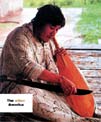
The Spanish colonial architecture of Sucre is something to behold. Sucre came into existence in 1538. Ever since then it has been considered Bolivia's cultural capital. It was here that independence was declared in 1825. Named after its liberator, Simon Bolivar, Bolivia is home to an impressive array of traditional weaving. The Museo Textil Etnografico contains definitive examples of traditional weaving. At present,the Museum is reviving the art of weaving in the surrounding villages. The weaving is done on a drop spindle or a heddle loom. Initially llama and alpaca wools were used, now sheep's wool is commonplace. Detailed zoomorphic patterns are traditional - fanciful animal forms, of birds and horses in particular are popular. The rare red and black designs from Potolo are especially sought after. The finest work combines expert spinning and a tight weave. In the past only women did the weaving, now men are being encouraged to take up the hand looms resulting in a whole new style and set of imagery evolving. The colours are stronger and motifs are more angular and energetic. The Museum has fine examples of bags, ponchos and mantas (blankets) from Tarabuco, Candelaria and Potolo.
+++